Case Studies > UK Certification
Exploring Solutions to Improve Thermal Comfort in a Contemporary Residential Design
| About | Part O TM59 overheating assessment for a contemporary residence with double-height spaces and extensive glazing | 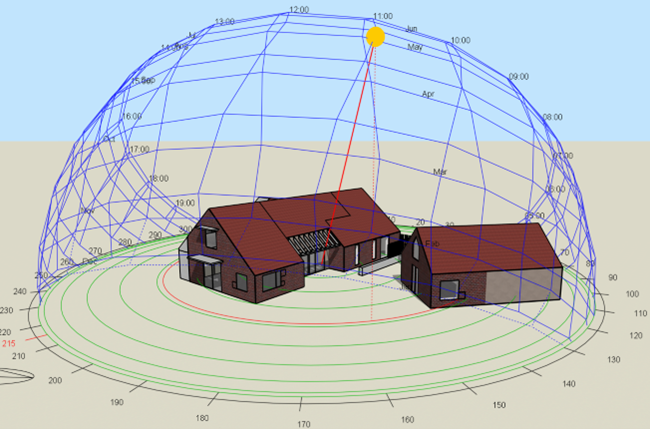 |
| By | Environmental Economics Limited | |
| Location | Cambridge, UK | |
| Category | TM59, Part O | |
| Highlights |
|
Abstract
This project involved conducting a Part O TM59 overheating assessment for a contemporary residence whose design features, such as double-height spaces and extensive glazing, presented significant thermal performance challenges. A series of mitigation strategies were systematically tested, including reducing window sizes, reducing the glazing g-values, testing internal shading solutions, and applying various active cooling options.
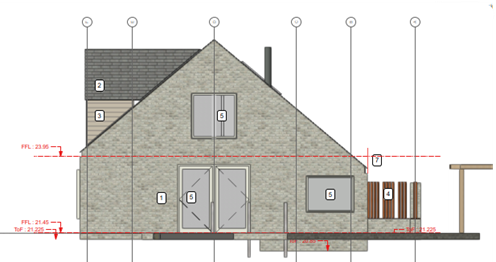
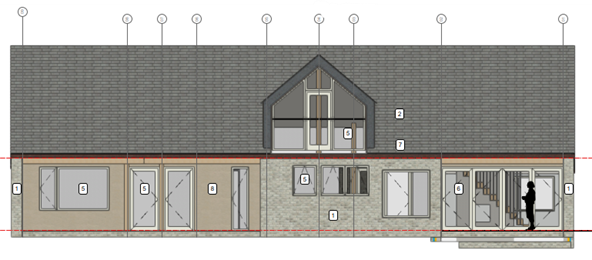
The results demonstrated that no single measure was sufficient to achieve compliance. Instead, a carefully selected combination of strategies was required. The final solution, integrating optimised window sizing, lower g-value glazing, 600 mm to 1000 mm overhangs above some windows and French doors for shading, and active cooling systems, successfully met all Part O TM59 assessment requirements and ensured acceptable thermal comfort throughout the dwelling.
Introduction
This contemporary residential development is defined by its striking double-height spaces and extensive glazed façades. The primary objective of the project was to achieve full compliance with Approved Document O (ADO) 2021 by providing a critical evaluation of overheating risk in residential buildings. A key challenge arose from the use of the appropriate local weather file, London Gatwick, which, when combined with the dwelling’s high passive solar-gain potential and limited opportunities for natural ventilation, significantly increased the risk of overheating.
Compounding this issue was the absence of surrounding buildings that could contribute to external shading. Although trees were present on the site, ADO guidelines specify that foliage cannot be taken into account in overheating assessments to reduce solar gains. This further limited opportunities for passive mitigation and intensified the challenge posed by the design.
Methodology
To address these challenges, a detailed dynamic thermal simulation model was constructed in DesignBuilder, serving as the primary analytical tool for evaluating and optimising various design strategies.
The assessment began with a series of interventions to reduce overheating. These were tested sequentially as follows:
- Window optimisation: Systematic exploration of different window opening configurations and their effect on natural ventilation.
- Window restrictors: Introduction of maximum 100mm restrictors on ground-floor Part Q windows to allow secure night-time ventilation.
- Glazing modifications: Reducing the glazing g-value to 0.4 to minimise solar heat gain.
- Internal shutters: Assessing the effectiveness of internal shading solutions.
- Active cooling systems: Mainly targeting June, July & August months when the habitable spaces are most at risk of overheating (see figure below).
Initial testing included reversible underfloor cooling and evaporative cooling/water-cooled air-conditioning systems.
Detailed analysis of simulation results guided the selection of an optimal combination of strategies to achieve thermal comfort and compliance.
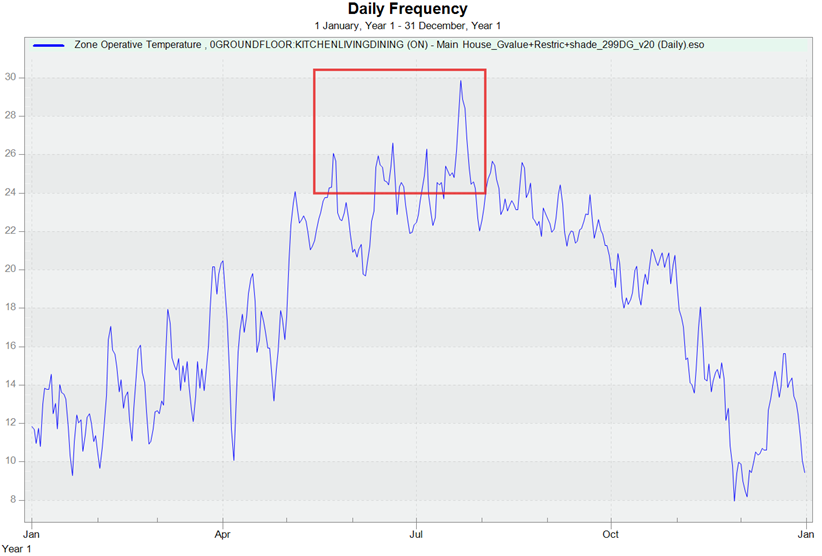
Distribution of overheating occurrences across the year, highlighting the months with the greatest intensity.
Conclusions
The TM59 overheating assessment, utilising DesignBuilder's detailed simulation capabilities, was successfully completed for the dwelling. The iterative modelling approach enabled precise quantification of overheating risk and rapid testing of multiple mitigation strategies. Key successes included verifying the effectiveness of integrating lower g-value glazing, strategic shading, and optimising operable window sizes.
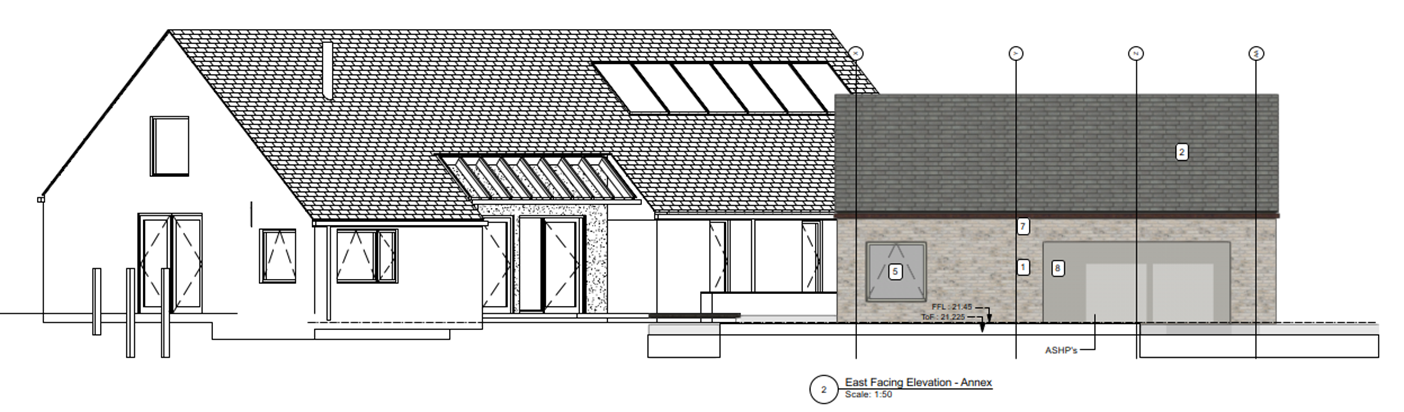
Crucially, the simulation confirmed that the application of targeted active cooling (water-cooled air conditioning) in the high-gain kitchen/living area, combined with fans in the bedrooms, was the defining factor in achieving compliance. This final strategy demonstrated a significant improvement in thermal comfort, validating the project’s complex design against regulatory standards and ensuring a habitable environment for the client. Although it was not extensively reported on in this case study, the annex was also included in the scope of the assessment, but did not require any mitigation. Overall, the study demonstrates how the advanced simulation capabilities of the DesignBuilder enabled a holistic evaluation of overheating risk, allowing multiple mitigation strategies to be tested and optimised to achieve TM59 compliance and ensure comfortable indoor conditions.
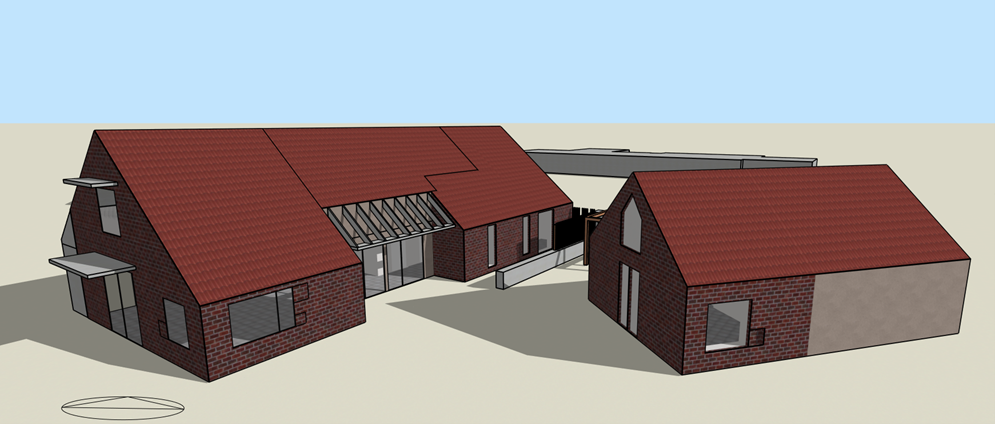
Visualising the design with all the external mitigations (external shading) in place.
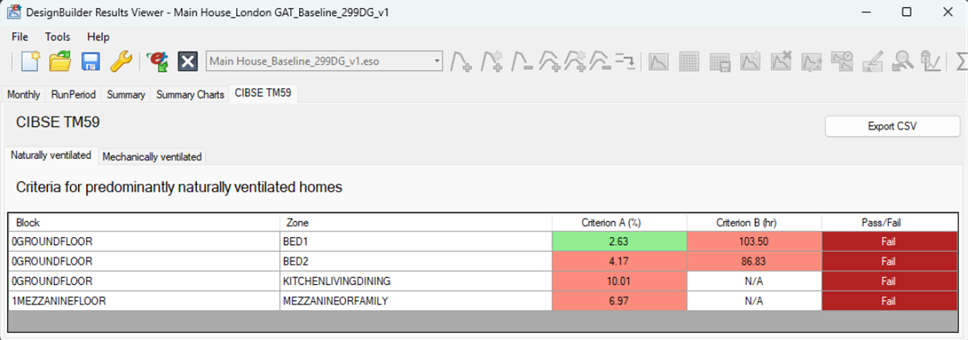
Baseline result of the main building showing all zones failing TM59 criteria.
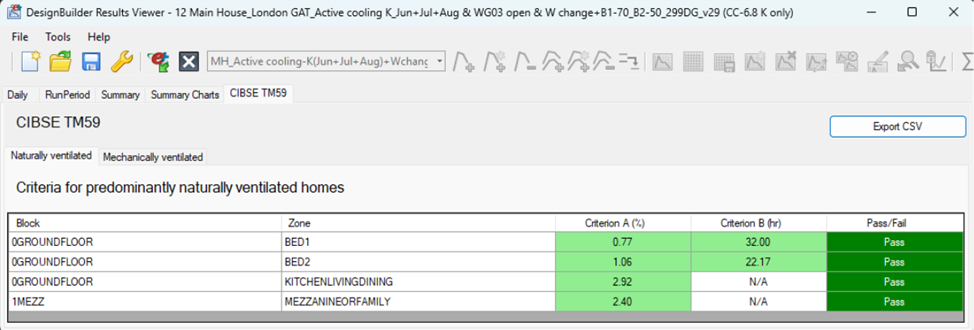
Mitigation result of the main building through a combination of low g-value (0.4), secure opening (restrictors), window size changes, active cooling and overheating fans up to (70 l/s).
 |
About the authorAbhishek Bholagir - TM59 overheating consultant
|